IATA Calls for Stronger Transport Security Through Collaboration and Innovation
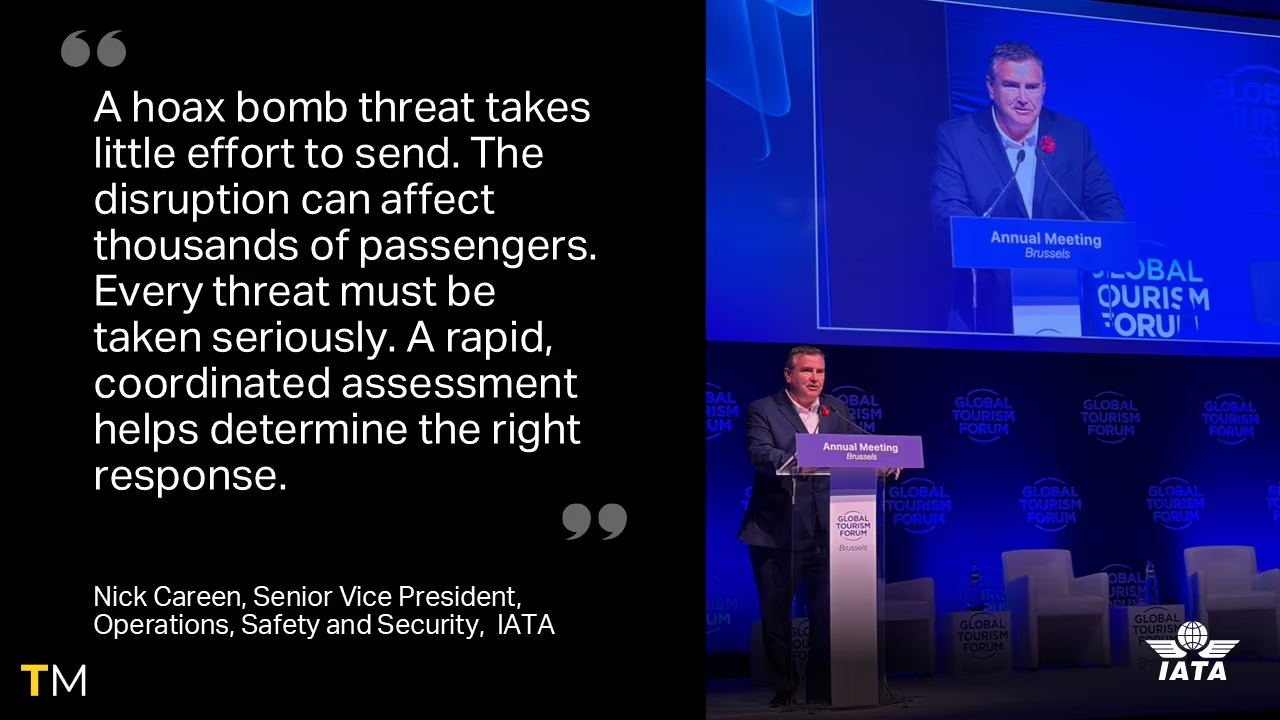
Speaking at the Global Tourism Forum Annual Meeting 2026 in Brussels, Nick Careen, IATA Senior Vice President, Operations, Safety & Security, stressed that tourism depends on trust, and trust depends on secure, resilient transport systems.
Emerging Security Threats
Careen highlighted several recent incidents that demonstrate evolving risks beyond traditional airport screening:
-
Drone-related disruption at London's Gatwick Airport.
-
GPS/GNSS interference affecting airline operations.
-
Cyberattacks impacting airport systems.
-
Hoax bomb threats causing flight diversions and passenger delays across Europe.
Priority 1: Governments and Industry Must Work as One Team
-
Effective security requires cooperation among airlines, airports, governments, military and law enforcement agencies.
-
Faster and more reliable information-sharing is essential during crises.
-
Airlines should be involved in decision-making processes that directly affect flight operations and passenger services.
-
Strong coordination is also needed for conflict-zone risk management and drone-related disruptions.
Priority 2: Adopt a Risk-Based Security Approach
-
Security measures should focus on actual risk rather than adding layers of regulations.
-
Threat assessments should be based on credibility and severity.
-
Airlines and airports should be recognized for implementing mature Security Management Systems.
-
Industry consultation can help ensure new security measures are practical, effective and proportionate.
Priority 3: Recognize Security Standards Instead of Repeating Them
-
Expand the principle of One-Stop Security, where passengers and baggage screened to equivalent standards do not undergo repeated checks.
-
Encourage mutual recognition of security processes between Europe and trusted international partners.
-
Reduce unnecessary duplication while maintaining safety standards.
Improving Border and Travel Processes
-
Ensure smooth implementation of Europe's Entry/Exit System (EES) and future ETIAS travel authorization system.
-
Establish clear performance benchmarks to minimize delays and operational disruptions.
-
Improve communication with travelers during system rollouts and peak travel periods.
Digital Identity and Biometrics
-
IATA supports broader use of secure digital identities and biometric technology.
-
According to IATA's Global Passenger Survey, most travelers are willing to use digital biometrics for a smoother journey.
-
Digital identity can reduce repetitive document checks and streamline passenger processing.
Security Lessons for All Transport Sectors
-
Many aviation security challenges also affect maritime and other transport sectors.
-
Greater cross-sector cooperation can help improve resilience and avoid repeating lessons learned independently.
IATA's Three Main Recommendations
-
Work as one team through stronger public-private collaboration and information sharing.
-
Make security more risk-based by leveraging operator expertise and focusing on real threats.
-
Recognize equivalent security standards instead of duplicating processes and inspections.
Why It Matters
-
Modern threats such as drones, cyberattacks and satellite-navigation interference do not respect organizational or national boundaries.
-
Stronger collaboration, smarter risk management and seamless security processes will help maintain traveler confidence, protect critical transport infrastructure and support the continued growth of tourism and global connectivity.