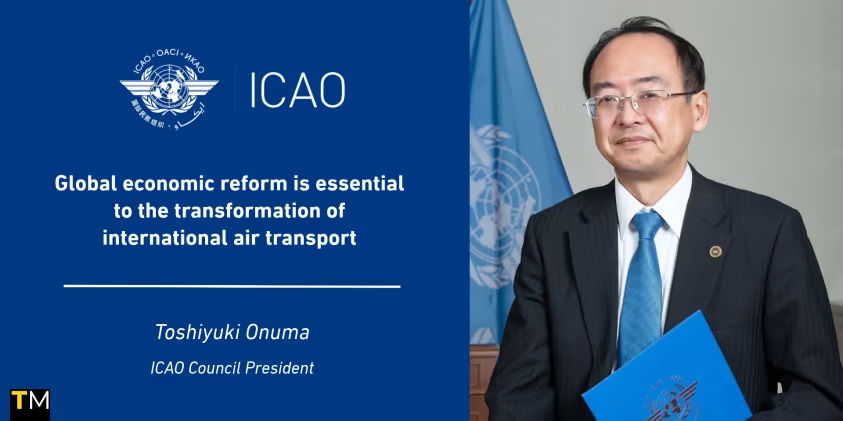
ICAO Calls for Global Economic Reforms to Transform International Air Transport
A new global economic framework will define the next era of international air transport. As aviation faces rapid technological advancement, climate ambition, and evolving global demand, the rules and systems that once sustained its growth must once again adapt to build a resilient, sustainable, and inclusive future.
Global Aviation Economic Reforms
- The International Civil Aviation Organization (ICAO) has highlighted the need for comprehensive global economic reforms to transform international air transport.
- The reforms aim to modernise the aviation industry's economic and regulatory framework.
- The initiative seeks to build a more resilient, sustainable and inclusive global aviation sector.
- ICAO emphasises the importance of international cooperation to address the industry's evolving challenges.
. Worldwide Air Transport Conference
- ICAO will convene its Seventh Worldwide Air Transport Conference (ATConf/7) beginning 16 November 2026.
- The five-day conference will bring together:
- Governments and aviation regulators.
- Airline and airport industry representatives.
- Financial institutions and investors.
- International aviation organisations.
- Other global stakeholders.
- The discussions will focus on reshaping aviation's global economic framework to meet future industry requirements.
Need to Modernise Aviation Regulations
- The existing international aviation framework was established through the 1944 Convention on International Civil Aviation.
- ICAO has continuously updated aviation policies through its Worldwide Air Transport Conferences.
- The previous conference, held more than a decade ago, produced economic policy recommendations that helped prepare the industry for major changes.
- The ICAO Long-Term Vision for International Air Transport Liberalization has supported the development of new air service markets, particularly in emerging economies.
- Further reforms are now required to address changing technologies, market conditions and operational requirements.
Challenges Facing the Global Aviation Industry
ICAO has identified several challenges affecting the industry's long-term growth and resilience:
- Infrastructure capacity constraints.
- Outdated economic regulatory frameworks.
- Persistent global supply-chain disruptions.
- Increasing financing constraints.
- Geopolitical tensions and airspace disruptions.
- Energy price volatility.
- Global macroeconomic uncertainty.
- Growing cybersecurity and data governance concerns.
- Shortages of skilled aviation professionals.
- Climate change and environmental sustainability requirements.
COVID-19 Pandemic and Industry Resilience
- The COVID-19 pandemic caused the most serious crisis in aviation history.
- The crisis resulted in a sharp decline in passenger demand and significant financial pressure on airlines and aviation businesses.
- Geopolitical tensions, airspace disruptions and economic uncertainty have continued to test the industry's resilience.
- ICAO believes that stronger economic policies and regulatory frameworks are essential to protect the industry's future.
Passenger Traffic Expected to Reach 12.4 Billion by 2050
- Global passenger numbers are projected to reach approximately 12.4 billion by 2050.
- This represents an estimated three-fold increase.
- Existing aviation systems and regulatory frameworks will need to evolve to accommodate the expected growth.
- Modern infrastructure, innovative business models and long-term investment will be essential.
- ICAO aims to ensure that future aviation growth remains responsible, inclusive and sustainable.
Focus on Emerging Aviation Technologies
- The conference will address the commercial viability of emerging aviation technologies.
- Discussions will focus on supporting new operational models.
- Updated economic regulations will provide greater certainty for long-term investment.
- The reforms are expected to encourage innovation and improve the competitiveness of international air transport.
ICAO Strategic Plan 2026–2050
- The conference will coincide with the launch of ICAO's Strategic Plan for 2050.
- The blueprint promotes the vision of 'Air Transport for All'.
- Its key ambitions include:
- Zero aviation fatalities.
- Net-zero carbon emissions.
- Greater global air connectivity.
- Inclusive access to air transport.
- Sustainable aviation development.
- Stronger international cooperation.
ICAO Leadership and Vision
- Toshiyuki Onuma, President of the ICAO Council, emphasised the importance of developing a new global economic framework for international aviation.
- He highlighted the need for international cooperation to address technological developments, climate ambitions and changing global travel demand.
- He noted that decisions taken at the conference will influence how aviation serves humanity and supports the global economy through 2050 and beyond.